SUI LIN TAM
ASD - 123
Accessible Speech Development is an engaging mobile application crafted to support children in enhancing their speech and language abilities. Featuring a diverse range of games, this interactive platform utilizes cutting-edge AI and voice technology to provide a dynamic learning experience for children. Not only does it foster greater interactivity for the young users, but it also empowers parents to actively participate in and facilitate communication with their children.

Problem
The current state of ASD123 was a basic app to showcase the app’s functionality with voice-commanded games to clients and speech pathologists. Although the games worked perfectly, it lacked an onboarding system to better understand the child’s needs, a cohesive design system, and a clear navigation flow.
Goal
Create an application that both parents and speech language pathologists have access to in order to maintain progress in development and motivation with the child, while keeping in mind best practices for accessibility and UI for children.
My Role
Product Manager and Co - UX Researcher and UI Designer
Collaboration
Expressing gratitude to our fantastic clients ASD123, Sheeva Abolhassani and Ravindra Babu for their open-mindedness and collaboration. A special thanks to my team members Catherine Geissler, Richie Hao, and Ayami Cho for their great contributions to the project!
Research
UI Research
Onboarding
Competitive Analysis
Affinity Mapping
User Interviews
Personas
ASD - 123'S MISSION
The wait time for a child to receive speech therapy services (in the public sector) in America can range from 18 months to 2 years. For guardians who can afford weekly private lessons, each appointment will cost anywhere between $100 to $300 out-of-pocket per appointment. ASD -123’s founders sought out to bypass the red tape in the speech therapy field by creating an interactive gaming platform helping children develop speech and language skills through the innovative use of AI and voice technology. Data analytics delivers comprehensive progress tracking to ensure effective learning, making their platform a much needed service within the industry.
initial assumptions
My team and I dedicated several days to researching the role of a speech language pathologist, understanding the mindset of an autistic child, and exploring how web accessibility principles could be responsibly applied to create a user interface prioritizing the needs and sensitivities of young minds with autism.
While meeting with our clients, we learned that while their initial product roadmap focused on an app for clinical use, the founders envisioned its broader potential for all children, planning to offer over 500 games on their platform. Understanding these long-term goals guided us in prioritizing short-term objectives crucial for setting up their app for success in achieving this vision.
To ensure ASD -123's platform success, we identified three key points:
1. An Updated Navigation System - Tracking progress, as children navigate through the app from one activity to the next.
2. An Updated Design System - Creating a more playing and fun experience for children to learn, while still keeping accessibility in mind.
3. Onboarding Experiences - Creating a more personalized and curated experience for the children to progress in development.
Pain PointS: CURRENT STATE
1. Lack of Engagement - while children love interacting with smart devices, there was little to nothing when it came to engagement back to the child.
2. Taking Action After Sessions - Parents and caretakers were unsure of how to interact with their child after sessions with their speech pathologists.
3. Tracking Progress - There was lack of progress and retention in speech development in children and they needed to figure out a way to reduce regression.
UI RESEARCH
In the project's initial stages, our focus was primarily on designing for children with autism. However, as the project evolved, our client broadened the scope to encompass all children. In the early research phase, I played a role in investigating colors and accessibility, particularly exploring their impact on individuals with autism. Our findings revealed that certain colors, such as red, had adverse effects.
In response, we made a strategic decision to adopt a neutral pastel palette with soothing and calming tones, intended to benefit all children. Bold colors were reserved specifically for action buttons, ensuring a thoughtful and inclusive design approach.
Our emphasis on selecting a careful color scheme stemmed from the understanding that colors can influence children both emotionally and physically, playing a role in their productivity and brain growth. Creating a visually appealing and calming environment became a priority.
Furthermore, our exploration extended to the realm of physical interactive games designed for children, and those on mobile devices. Special attention was given to incorporating larger touch targets and ample white space when brainstorming for the design as well. This was an intentional approach aimed to support children in developing fine motor skills, ensuring that interactive elements were not only accessible but also conducive to their overall growth and engagement.
ONBOARDING
My primary focus during the research phase centered on enhancing the onboarding process for ASD-123. Initially, the app lacked a comprehensive onboarding experience, featuring only a quick sign-in and avatar selection. However, our investigation revealed the critical importance of this stage in the user journey.
We discovered that implementing an onboarding process involving a series of questions related to a child's speech development could significantly enhance the user experience. This personalized approach would allow the app to tailor its content, making users feel more comfortable and engaged. With statistics showing that one out of four users abandon an app after just one use, we recognized that a well-designed onboarding process could significantly impact user retention rates.
In addition to personalization, we prioritized the inclusion of a progress bar within the onboarding flow. This feature aimed to alleviate any sense of feeling "trapped" and help users maintain focus throughout the process. By incorporating these elements, we aimed to create a seamless and engaging onboarding experience that would set the stage for continued user engagement with the app.
competitive analysis
Through a comprehensive competitive analysis, we strategically examined four prominent competitors of ASD-123: Otismo, Inauguration/MITA, and Speech Blubs. Leveraging the week-long free trials provided by these platforms, we meticulously explored the features of each app.

Takeaways:
1. Rewards System - Our competitors utilized systems that effectively motivate children to persist in their practice by offering enticing prizes upon completing lessons. These apps strategically incentivize learning and lesson completion, creating a rewarding mechanism that encourages continuous engagement and achievement to unlock additional rewards.
2. Journey Tracking - Our competitors also Incorporated a progression system within the app, proving to be beneficial for both children and adults, providing a clear insight into their performance in lessons and the milestones achieved with each completed session.
User Interviews
We interviewed 7 users from the ages of 25-43, consisting of: 1 special education teacher, 2 guardians of nonverbal children and 4 speech pathologists. It was important that we gain insights from all potential users of the app, being educators, therapists and guardians. The interviews were conducted over the phone and lasted around 30 minutes.
quotes


Through our questionnaire, we identified three major trends:
1. The desire for therapists and educators to encourage parent/guardian involvement, as well as the desire for parents to be involved, but not knowing exactly how.
2. The need for freedom of choice, positive reinforcement and feedback for children was a major trend and contributing factor in our design solutions.
3. A visual, interactive method of tracking progress has played a major role in encouraging autistic children in classroom settings. Aside from positive feedback, foresight was the other main source of engagement, with educators and parents both reporting that when an autistic child is introduced to unforeseen changes, a rapid decline in mood could occur and contribute to regression.
Affinity mapping
After synthesizing our User Interview findings into an Affinity Map, we came up with 5 takeaways:
1. Reduce Distractions - Eliminating distractions plays a major role in how engaged an autistic child is during therapy.
2. Track and Encourage Progress & Predictability by Setting Goals - The biggest challenge for therapists and educators was motivating clients. Methods that have shown promising results revolved around the client having a visual motivator that not only kept them engaged, but also helped us remove any surprise elements that would upset them.
3. Transactional Motivation - Many therapists expressed the need for a buy-in, stating that their clients will cease to participate if there is nothing in it for them.
4. Variety and Freedom of Choice - Autistic children tend to have niche interests and respond well to therapy when they are introduced to a wide array of games along with the freedom of choice.
5. Calming Colors and Visuals - Hypoactivity and hyperactivity exist on the spectrum. In order to accommodate the two, it is important to implement visual design choices within an experience option (by toggle) that incorporate cool colors, soft fonts and an overall soothing design.
personas
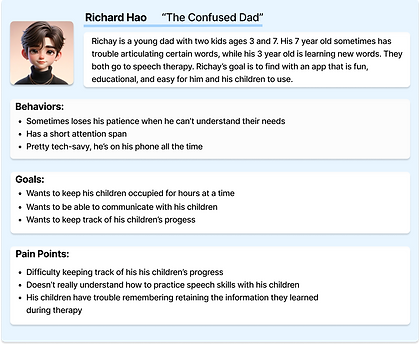
Concluding the research phase, I developed personas derived from our interviews to enhance our team's understanding of user goals, motivations, needs, and pain points. The personas include a speech pathologist, a child, and an adult, providing comprehensive insights into the diverse perspectives of our user base.

DESIGN
User Flows
Design Studio
User Testing
Prototyping
mid - fidelity prototype

design studio
Concluding the research phase, I developed personas derived from our interviews to enhance our team's understanding of user goals, motivations, needs, and pain points. The personas include a speech pathologist, a child, and an adult, providing comprehensive insights into the diverse perspectives of our user base.
Design System: We crafted a design system guide aligned with ASD-123's brand identity of emphasizing accessibility, readability, and playfulness. This guide encompasses various elements, ranging from different logo versions to the color palette, typography, buttons, and more.
Onboarding Flow: My focus on design was primarily crafting the onboarding screens. These screens were designed to include specific questions geared towards defining practice goals, integrating specialized code for speech therapists, and exploring detailed inquiries customized to the child's profile. The categories encompassed in these inquiries ranged from hearing and speech to empathy, play, and comprehension. As per our research findings, we ensured the inclusion of a progress bar at the top of the screens for seamless tracking of the questions.
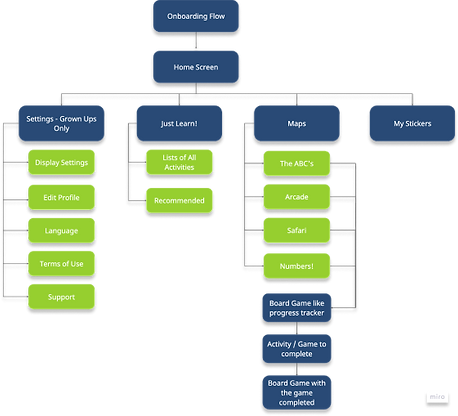
Navigation System: We created user flows to create a clear navigation system.
1. My Maps - From our Competitive Analysis takeaways, we curated a new way for children to track their own progress and improve their skills. Drawing insights from the onboarding assessment, the maps are meticulously curated to align with the child's proficiency level and specific interests.
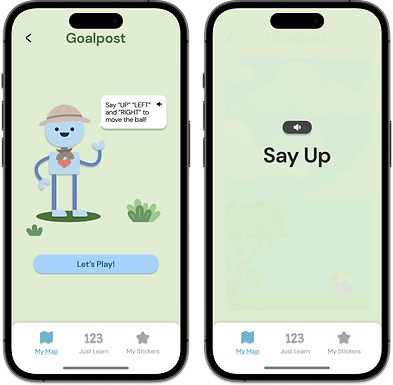
2. Activities - The in-activity navigation emerged as a pivotal component in the revamped app. Informed by our research, we conscientiously incorporated best practices for accessibility, ensuring the inclusion of a feature allowing the child to practice before immersing themselves in the game.
3. My Stickers - To foster and sustain children's engagement during their activities, we integrated a reward system, inspired from our competitors. Upon completing each lesson, children receive stickers that they can place on corresponding shapes to fill up their sticker page. Responding to our clients' suggestion for added enjoyment, we seized the opportunity during the project timeline to include a camera feature. This would allow users to put on the digital stickers as filters in real-life settings, enhancing the interactivity and fun of the app.
4. Just Learn - While the emphasis on progress tracking and the Map feature was crucial for the enhanced navigation system, we also aimed to empower parents and children by offering the option to choose individual games from a list of games.
5. Settings - Based on our competitive research, we observed a common trend among multiple apps featuring a "Grown Ups Only" section. This dedicated area ensures that children do not access certain settings, maintaining a secure and controlled environment for parental access.






user testing
Just prior to finalizing our high-fidelity prototype, we conducted user testing and identified challenges users faced in accessing in-app settings, particularly when prompted to enable vivid mode. In response, we revamped the iconography and adjusted visual graphics to ensure a more uniform and professional appearance, addressing the issues raised during testing.

ASD - 123 PROTOTYPE

NEXT STEPS
As we approached the completion of the project, we offered our clients a set of additional recommendations for the subsequent phases and potential next steps to further enhance the project's success.
-
Speech Pathologist View: While designing the application from the child's perspective, we recommend developing a clinical version. In this version, speech therapists would have the capability to customize their view and exert control over the content and activities that the child engages with during therapy sessions.
-
More Personalized Games: With the incorporation of over 500+ games into the application, there is ample opportunity for additional categorization and curation, especially within the "Just Learn" games. Enhancements in how children navigate through this extensive list could further optimize the user experience.
-
Conduct Further Testing: After completing the steps above, it is advisable to conduct another round of testing with children, parents, and speech pathologists to ensure that the application meets their needs and expectations.
Research Report for more information:
Thoughts
Working with our clients at ASD -123 was a truly rewarding experience, especially considering this was our first client-led project. They proved to be a delightful and collaborative partner, and I felt privileged to contribute to their mission of aiding children, their families, and speech pathologists. While the team collaboration presented some challenges, my role as a product manager involved ensuring a smooth process, and I made a conscious effort to voice concerns when necessary. Special appreciation goes to Catherine Giessler for her kindness, support, and remarkable research abilities. The clients expressed immense satisfaction with the results, and I consider our success and professionalism in delivering the project as a significant achievement.